


An Alliance-Level Learning Ecosystem for Innovative Teaching and Learning
“Co-creating knowledge, sharing good practices, and building a sustainable EELISA learning ecosystem.”
EELISA Co-Learning Lab 2026 (EELISA CLL 2026) is an Alliance-level learning event designed to bring together academics, students, educational developers, learning centres, graduate schools, EELISA Communities, practitioners, and external stakeholders from across the EELISA European University.
The Lab creates a shared space for peer learning, co-creation, pedagogical innovation, and institutional transformation in higher education. It supports the exchange, review, improvement, documentation, and scaling of innovative teaching and learning practices across the Alliance.
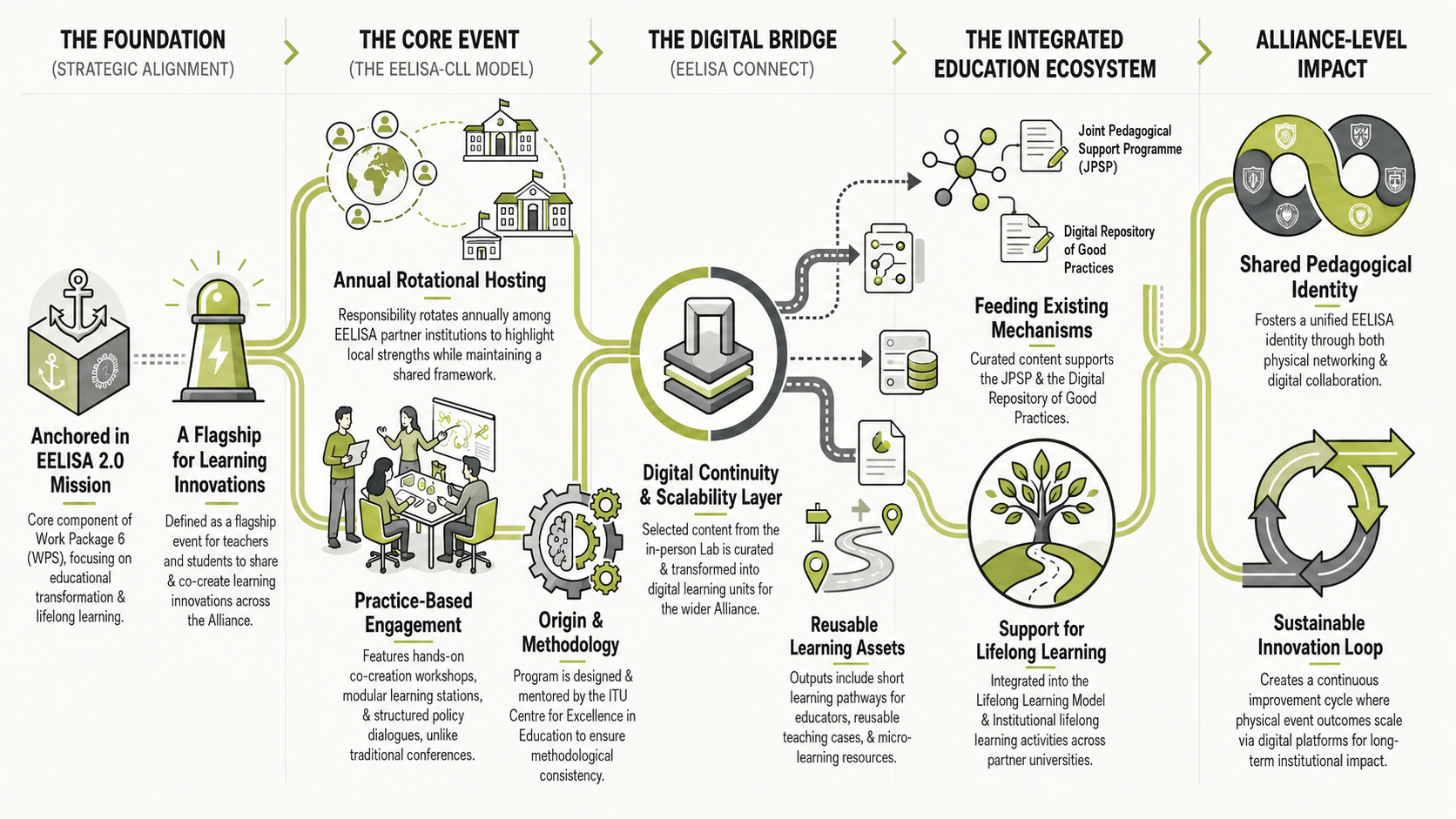
Rather than functioning as a conventional conference, the EELISA Co-Learning Lab is conceived as a practice-oriented learning environment that consolidates various outputs and outcomes from the EELISA to create impact at the Alliance level. In this sense, selected good practices are not only presented and discussed, but also further developed into transferable learning resources, Learning Stations, and follow-up training opportunities for the wider EELISA ecosystem.
The EELISA Co-Learning Lab 2026 aims to:
- Disseminate innovative teaching and learning practices through peer-reviewed, practice-oriented formats.
- Strengthen pedagogical capacity among academics, educational developers, learning centre staff, and students across the Alliance.
- Promote cross-institutional and interdisciplinary dialogue on learning design, assessment, educational innovation, and institutional transformation.
- Support the adaptation and scaling of good practices across different EELISA institutions, disciplines, and learning environments.
- Transform selected Co-Learning Lab outputs into structured learning resources for EELISA Connect / Digital Campus and related Alliance-level platforms.
- Produce a digital and interactive extended abstract book (e.g., ITU Co-learning Lab 2025) that presents selected good practices, enables wider dissemination, and supports future collaboration.
- Create stronger links between education and research by transforming graduate thesis outputs into learning experiences.
- Contribute to a shared EELISA pedagogical identity by connecting local innovation practices with Alliance-level learning goals.
The 2026 edition focuses on three interconnected priorities:
- Sharing and scaling good practices in innovative teaching and learning across EELISA institutions, as part of the EELISA Lifelong Learning Model.
- Transforming good practices and graduate research outputs into collective learning experiences.
- Creating reusable learning assets for EELISA Connect / EELISA Digital Campus and the Digital Repository of Good Practices.
Important Dates
| Step | Date |
|---|---|
| Save the Date announcement | June 2026 |
| Call for extended abstracts opens | June 2026 |
| Deadline for extended abstract submission | 2 October 2026 |
| Review period | 25 September - 16 October 2026 |
| Notification of acceptance | 16 October 2026 |
| Deadline for revised extended abstracts | 23 October 2026 |
| Announcement of detailed programme | 9 November 2026 |
| Deadline for participant registration | 2 November 2026 |
| EELISA Co-Learning Lab 2026 | 26–27 November 2026 |
| Post-event Training of Trainers / mentoring period | December 2026 – October 2027 |
| Publication of extended abstract book | First quarter of 2027 |
Final dates will be confirmed in coordination with EELISA partner institutions, the Scientific Committee, the Organizing Committee, and the relevant institutional units.
Event Info
| Item | Information |
|---|---|
| Event Title | EELISA Co-Learning Lab 2026 |
| Date | 26–27 November 2026 |
| Venue | Istanbul Technical University, Istanbul, Türkiye |
| Format | Hybrid: on-site participation in Istanbul with selected online sessions |
| Language | English |
| Host institution | Istanbul Technical University |
| Coordinating unit | ITU Centre for Excellence in Education (ITU CEE) and ITU EELISA Local Office (ITU ELO) |
| Main focus | Innovative teaching and learning, good-practice exchange, thesis-to-learning-experience transformation, and reusable learning resources for the EELISA ecosystem |
| Target audience | Academics, students, educational developers, learning-centre staff, graduate schools, EELISA Communities, practitioners, alumni, and external stakeholders from EELISA partner institutions |
| Participation | Primarily open to EELISA partner institutions; selected sessions may be open to wider higher education stakeholders |
| Mobility support | Partner institutions will be invited to indicate the number of participants eligible for mobility support, in line with their available resources and internal procedures |
| Expected outputs | Selected good practices, Training of Trainers / Learning Station outputs, peer-reviewed digital extended abstract book (e.g., ITU Co-learning Lab 2025), and reusable learning assets for EELISA platforms |
| Contact | ITU Centre for Excellence in Education (ITU CEE) mukemmeliyet@itu.edu.tr / ITU EELISA Local Office (ITU ELO) eelisa@itu.edu.tr |
Call for Extended Abstracts
The EELISA Co-Learning Lab 2026 invites academics, students, learning centre staff, educational developers, researchers, and practitioners from EELISA institutions to submit extended abstracts presenting innovative teaching and learning good practices. Authors should demonstrate clear educational value, relevance to the EELISA mission, potential for transferability across disciplines and institutions, and, where possible, evidence of impact.
The EELISA Co-Learning Lab 2026 will be organized around two main tracks.
Track 1: Innovative Teaching and Learning Good Practices
This track focuses on the exchange, experimentation, and use of good practices in innovative teaching and learning.
It invites academics, students, learning centre staff, educational developers, and practitioners from EELISA institutions to submit practice-based contributions that demonstrate how innovative pedagogies are designed, implemented, evaluated, and improved.
Authors may address, but are not limited to:
- active learning approaches;
- challenge-based learning;
- project-based learning;
- collaborative learning;
- research-based learning;
- inclusive learning practices;
- digital and hybrid learning;
- artificial intelligence in education;
- gamification in education;
- assessment and feedback practices;
- learning analytics and evidence-based teaching;
- interdisciplinary course design;
- sustainability-oriented education;
- civic engagement and community-based learning;
- lifelong learning;
- micro-credentials and modular learning;
- student engagement and motivation;
- soft skills development;
- syllabus and curriculum design;
- educational psychology;
- classroom management;
- academic orientation;
- industry-linked learning experiences.
The purpose of this track is not only to present successful examples, but also to discuss their transferability, limitations, evidence of impact, and potential for scaling within the Alliance.
Track 2: From Theses to Learning Stations
This track focuses on transforming graduate research outputs into innovative learning experiences.
Graduate theses, research projects, doctoral studies, and research-based outputs can generate valuable knowledge for wider audiences. However, these outputs often remain limited to academic publications, thesis repositories, or disciplinary communities. The EELISA Co-Learning Lab aims to explore how such research outputs can be translated into accessible, modular, and interactive learning experiences.
Through the Learning Station model, selected thesis-based proposals may be transformed into structured learning experiences for:
- students;
- academics;
- alumni;
- lifelong learners;
- professional groups;
- EELISA Communities;
- external stakeholders;
- industry and public-sector partners.
This track is particularly relevant for graduate students, thesis advisors, early-career researchers, and research teams interested in transforming research into educational impact.
Extended Abstract Submission
Both submission types should clearly demonstrate how the proposed contribution can support peer learning, pedagogical innovation, transferability, and long-term use across the EELISA Alliance.
To help you prepare a complete submission, you may also consult the evaluation form that will be shared with reviewers here: Reviewer Evaluation Form
Expected Outputs
The EELISA Co-Learning Lab 2026 is expected to generate concrete outputs before, during, and after the event. These outputs will support both immediate knowledge exchange and longer-term use across the EELISA learning ecosystem.
1. Reviewed and presented contributions
- selected good practices from EELISA partner institutions;
- reviewed extended abstracts;
- keynote and invited speakers;
- workshop and co-creation outputs.
2. Publication and documentation outputs
- digital and interactive extended abstract book (e.g., ITU Co-learning Lab 2025);
- event archive as part of Digital Repository of Good Practices.
3. Learning design and Training of Trainers outputs
- Training of Trainers outputs for the authors of selected extended abstracts;
- follow-up mentorship support to transform good practices into alliance-wide learning experiences.
4. Digital and ecosystem-level outputs
- reusable learning assets for EELISA Connect / Digital Campus;
- entries or resources for the Digital Repository of Good Practices;
- strengthened networks among EELISA educators, students, learning centres, graduate schools, communities, and external stakeholders.
Who Can Participate?
The EELISA Co-Learning Lab 2026 welcomes participation from all EELISA partner institutions and relevant stakeholders involved in innovative teaching, learning, research, and educational transformation.
The main target groups include:
Academic and teaching communities
- academics and teaching staff;
- graduate students, doctoral researchers, and supervisors;
- undergraduate students involved in learning innovation, student-led initiatives, or EELISA Communities.
Educational innovation and support units
- learning centres, teaching and learning centres, centres for excellence in education, and equivalent units;
- educational developers and instructional designers;
- graduate schools and units supporting research-based education.
EELISA actors and institutional teams
- EELISA Communities;
- Members of Teaching and Learning Centers
- Members of Lifelong Learning Centers / Continuing Professional Development Centers
External and ecosystem stakeholders
- practitioners from industry, public institutions, NGOs, and professional bodies;
- alumni and lifelong learning stakeholders;
- external contributors working on innovative higher education practices.
Each EELISA partner institution will be invited to identify relevant internal units and contributors who can actively support the exchange, development, review, and scaling of good practices within the Co-Learning Lab.
*Please contact your EELISA Local Office to explore mobility support capacity.
Benefits for Authors
Authors of accepted extended abstracts will have the opportunity to develop, share, and scale their work within the EELISA learning ecosystem.
Authors of accepted extended abstracts may:
- present their good practices to an international EELISA audience;
- receive structured feedback from peers, reviewers, educational developers, and invited experts;
- be included in a peer-reviewed digital extended abstract book;
- participate in Training of Trainers Programme and Learning Station development activities;
- receive methodological support for transforming their practices into reusable learning experiences;
- share their outputs through EELISA Connect / Digital Campus and the Digital Repository of Good Practices;
- contribute to Alliance-level educational transformation and the development of a shared EELISA pedagogical identity;
- build international networks with academics, students, learning centres, EELISA Communities, practitioners, and external stakeholders;
- be considered for recognition mechanisms such as good-practice presentation awards or EELISA-level teaching innovation recognition, subject to final confirmation.
Through this pathway, authors can move beyond presenting an example of good practice and take part in a structured process of review, refinement, recognition, and wider dissemination across the Alliance.
Review and Selection
Submitted proposals will be reviewed by the Scientific Committee according to their relevance, quality, transferability, and potential contribution to the EELISA learning ecosystem.
The review process will consider the following criteria:
The good practice:
- Proposal demonstrates a clear contribution to the EELISA learning ecosystem and Alliance-level educational transformation.
- Shows strong potential for transferability across EELISA institutions, disciplines, learner groups, or cultural contexts.
- Is aligned with learner-centred, challenge-based, active, inclusive, collaborative, or research-based learning approaches.
- Has potential to be transformed into a reusable learning module, or follow-up training activity.
- Demonstrates potential for long-term impact, not only as an event presentation but also as a reusable learning asset.
- Supports collaboration among different EELISA actors, such as academics, students, learning centres, EELISA Communities, practitioners, or external stakeholders.
- Proposal is clear, coherent, and well-structured in terms of objectives, methodology, implementation, outcomes, and expected contribution.
- Has potential to inspire wider audiences and stimulate peer learning, discussion, or co-creation during the Co-Learning Lab.
The authors:
- Clearly explain how the good practice can be adapted, scaled, or reused beyond its original institutional setting.
- Provide evidence of implementation, testing, piloting, user feedback, or lessons learned from the good practice.
- Clearly define the target learner group / stakeholder group and explain why the good practice is relevant for them.
- Explain how the outputs of the good practice may contribute to EELISA Connect / Digital Campus or the Digital Repository of Good Practices.
Programme
EELISA Co-Learning Lab 2026 will include the following components:
Co-Learning Lab
Day 1 — 26 November 2026
Opening and Alliance-Level Framing
- Opening addresses and EELISA Co-Learning Lab vision
- Keynote speeches by Emanuela Tilley and Mark Nichols
- Good practice presentations and invited SEFI speakers
- Challenge-based and community-based learning
Day 2 — 27 November 2026
Good Practices, Partnerships and Scaling
- Student-centred and AI-enabled learning practices
- Academia–industry co-creation and MathWorks perspective
- EELISA I-LEARN Community Forum
- Student challenge finals and closing session
Training of Trainers Programme
Challenge-Based Learning (CBL) Workshop — 24–25 November 2026
- Two-day workshop led by Mark Nichols, The Challenge Institute
- Challenge framing, learning design, facilitation and assessment

Learning Station Training — 27 November 2026
- Learning Station methodology and co-design workshop
- Introduction to the EELISA Connect platform
- Development of reusable learning modules and assets
MathWorks × EELISA Student Challenge — Work in progress
- Launch on 24 November; finals on 27 November
- Student-centred challenge using modelling and AI

Detailed Programme
24–27 November 2026 · Istanbul Technical University · Hybrid format
Preliminary programme. The programme is subject to confirmation. Invited speaker participation, industry contributions, workshop topics and student competition arrangements are still being finalised. Good-practice titles are working titles pending final verification.
CBL Workshop · Day 1
Learn: challenge framing and collaborative learning design
CBL Workshop · Day 1
Learn: challenge framing and collaborative learning design
Challenge-Based Learning (CBL) Workshop — Day 1
Facilitator: Mark Nichols, Head of The Challenge Institute. Detailed workshop content is indicative and subject to confirmation.
MathWorks × EELISA Student Challenge — Launch
Proposed student activity following the faculty workshop.
CBL Workshop · Day 2
Design: facilitation, assessment and pathways to scaling
CBL Workshop · Day 2
Design: facilitation, assessment and pathways to scaling
Challenge-Based Learning (CBL) Workshop — Day 2
Facilitator: Mark Nichols, Head of The Challenge Institute. Detailed workshop content is indicative and subject to confirmation.
Student Challenge — Optional Mentor Clinic
Parallel activity for student teams, independent of the CBL workshop.
From CBL to Collaborative Educational Innovation
Share: keynote addresses, invited perspectives and good practices
From CBL to Collaborative Educational Innovation
Share: keynote addresses, invited perspectives and good practices
Opening and Keynote Addresses
Alliance-level perspectives on educational transformation.
Session 1 — Challenge- and Project-Based Engineering Education
Moderator: To be confirmed
From CBL activities and teaching practices to curriculum-level adoption.
Session 2 — Sustainability, Community and Collaborative Learning
Moderator: To be confirmed
Designing interdisciplinary and community-based learning experiences.
From Innovation to Co-Creation and Scaling
Scale: industry partnerships, AI, I-LEARN and Learning Stations
From Innovation to Co-Creation and Scaling
Scale: industry partnerships, AI, I-LEARN and Learning Stations
Session 3 — Active and Student-Centred Learning & Assessment
Moderator: To be confirmed
Evidence-based pedagogies, mentoring and authentic student assessment.
Session 4 — Academia–Industry Partnerships and AI in Education
Moderator: To be confirmed
Co-creation with external partners and AI-enabled learning innovation.
EELISA I-LEARN Community Forum
Moderator: To be confirmed
A facilitated exchange focused on uptake and reuse beyond individual courses.
Parallel Training and Student Activities
Simultaneous sessions
Training of Trainers
Challenge Based Learning Workshop
24-25 November 2026
Education is changing. Rapid advances in technology, including artificial intelligence, evolving professional practices, and increasingly complex challenges are reshaping the knowledge, skills, and dispositions learners need to thrive. The world needs, and employers increasingly value, graduates who can collaborate across disciplines, develop thoughtful responses to authentic challenges, adapt to change, and continue learning throughout their careers.
Challenge-Based Learning (CBL) offers a practical response to these shifts. By engaging learners in meaningful challenges, CBL integrates disciplinary knowledge, skill development, collaboration, reflection, and action in ways that mirror the complexity of the world beyond the classroom. By requiring learners to investigate, analyze, synthesize, create, and reflect, CBL helps guard against the cognitive bypass that can occur when technology is used to replace rather than support learning.
This two-day interactive workshop introduces Challenge-Based Learning by combining direct experience with practical design. Participants first experience CBL as learners by working through a real challenge and then apply what they have learned to design CBL experiences for their own courses and programs.
Designed for faculty, instructional designers, academic leaders, and learner support professionals, the workshop provides experience, practical tools, implementation strategies, and a collaborative planning process that can be adapted across disciplines.
Participants will:
- Experience the Engage, Investigate, and Act phases of CBL.
- Explore how CBL supports learning in the age of AI.
- Examine the role of inquiry, collaboration, and authentic assessment.
- Design a CBL experience appropriate for their own context.
- Leave with an implementation blueprint and next steps.
Click here to view the workshop programme.
Learning Station Training
27 November 2026
A distinctive component of the EELISA Co-Learning Lab is the Training of Trainers Programme for the owners of the good-practices and the participants.
The Training of Trainers process begins during the event and may continue afterwards through mentoring and methodological support. Authors of selected extended abstracts will be supported in refining their good practices into structured learning experiences that can be reused, adapted, and shared across the EELISA ecosystem.
This pathway will include:
- introduction to the Learning Station methodology;
- support for defining target groups, learning objectives, learning outcomes, activity flows, and assessment methods;
- transformation of good practices into reusable learning experiences;
- development of training-ready materials;
- mentoring for future dissemination and adaptation across EELISA institutions;
- alignment with EELISA Connect / Digital Campus and related repository requirements.
The aim is to ensure that the Co-Learning Lab produces not only event-based presentations, but also transferable learning experiences, follow-up training opportunities, and scalable learning assets for the Alliance.
Scientific Committee
| Name Surname | Profile page | Institution |
|---|---|---|
| Álvaro Ridruejo Rodrigez | Faculty of Materials Science | Technical University of Madrid (UPM) | |
| Ayşe Kılıç | Eindhoven School of Education, ESA Teacher Support and Quality Assurance Central team | Eindhoven University of Technology | |
| Balazs Nagy Vince | Department of Mechatronics, Optics and Engineering Informatics | Budapest University of Technology and Economics (BME) | |
| Claude Müller Werder | Head of Center for Innovative Teaching and Learning | Zurich University of Applied Sciences (ZHAW) | |
| Douglas K. Hartman | Department of Teacher Education & Ed Psych/Ed Tech | Michigan State University | |
| Loredana Maria Manasia | Department of Teacher Education and Social Sciences | National University of Science and Technology Politehnica Bucharest (UNSTPB) | |
| Mariana Mocanu | Faculty of Automatic Control and Computers | National University of Science and Technology Politehnica Bucharest (UNSTPB) | |
| Nicoleta Litoiu | Faculty of Teaching Career and Social Sciences | National University of Science and Technology Politehnica Bucharest (UNSTPB) | |
| Ramón Martínez | Deputy Vice-Rector for Innovative Pedagogies | Technical University of Madrid (UPM) | |
| Stéphanie Merger | International Development and Sustainable Building Office | École nationale des ponts et chaussées (ENPC) | |
| Thibaut Skrzypek | Department of International Relations and Corporate Partnerships | École nationale des ponts et chaussées (ENPC) | |
| Yılmaz Akkaya | Department of Civil Engineering | Istanbul Technical University (ITU) | |
| Yuki Kaneko | Faculty of Engineering and Natural Sciences | Sabancı University | |
| Zuhal Zeybekoğlu | Director, Office of Learning and Teaching | Koç University |
The Scientific Committee members will be updated periodically
Organization Committee
EELISA European University Work Packages:
1WP5: Joint Education Offer and Recognition Frameworks
2WP6: Innovative Teaching and Learning Hubs
3WP8: Engagement with Society through EELISA Communities
Submit / Register
Co-Learning Lab
Register for Co-Learning Lab
November 26-27, 2026
Join the main EELISA Co-Learning Lab 2026 programme, including keynote sessions, good-practice presentations, discussions, and networking activities.
Submit Extended Abstract for Co-Learning Lab
November 26-27, 2026
Submit your good-practice abstract or thesis-to-learning-station proposal for review by the Scientific Committee.
Before submitting your good practice, please complete your event registration on EELISA Digital Campus
Training of Trainers
Register for Challenge-Based Learning Workshop
November 24-25, 2026
Join the pre-event workshop on challenge-based learning and explore practical approaches for designing learner-centred, collaborative learning experiences.
Learning Station Training
November 27, 2026
Apply to participate in the Training of Trainers pathway and develop selected good practices into Learning Stations or reusable learning resources. This hybrid training is open only to participants who present their good practices in the Co-learning Lab event.
A separate registration link will be sent to good practice owners, after their presentation
• EELISA has received co-funding from the European Union under GA No. 101124676 / EELISA-InnoCORE has received funding from the European Union’s Horizon 2020 R & I programme under GA No. 101035811
• Funded by the European Union. Views and opinions expressed are however those of the author(s) only and do not necessarily reflect those of the European Union or the European Education and Culture Executive Agency (EACEA). Neither the European Union nor EACEA can be held responsible for them.